AI agents are priced in four main ways in 2026: per outcome, per resolution, per conversation, and per seat. The market is moving fast toward outcome based pricing, where you pay only when the agent actually solves something. This page explains each model and shows what the leading agents charge. We update it as pricing changes.
Most of the clearest pricing is in customer service, where agents are furthest along. The examples below use that market. This guide pairs with our AI customer service agents overview and our Decagon vs Sierra comparison.
What are the main AI agent pricing models?
There are four main AI agent pricing models in 2026.
- Per outcome: You pay when the agent reaches a defined result, like a solved ticket. You pay nothing when it fails or hands off.
- Per resolution: Similar to per outcome, tied to a resolved case. The terms are often used in the same way.
- Per conversation: You pay for each conversation the agent handles, whether or not it solves the issue.
- Per seat: You pay a fixed fee per human user per month, the old SaaS model. This is fading for agents.
Many vendors also add a yearly platform fee on top of usage, plus one time setup or implementation costs.
How much do AI customer service agents cost?
Here is what the leading AI customer service agents charge, based on reported 2026 pricing. Many of these vendors do not publish prices, so the figures come from public listings and reported contracts. Treat them as a guide, not a quote.
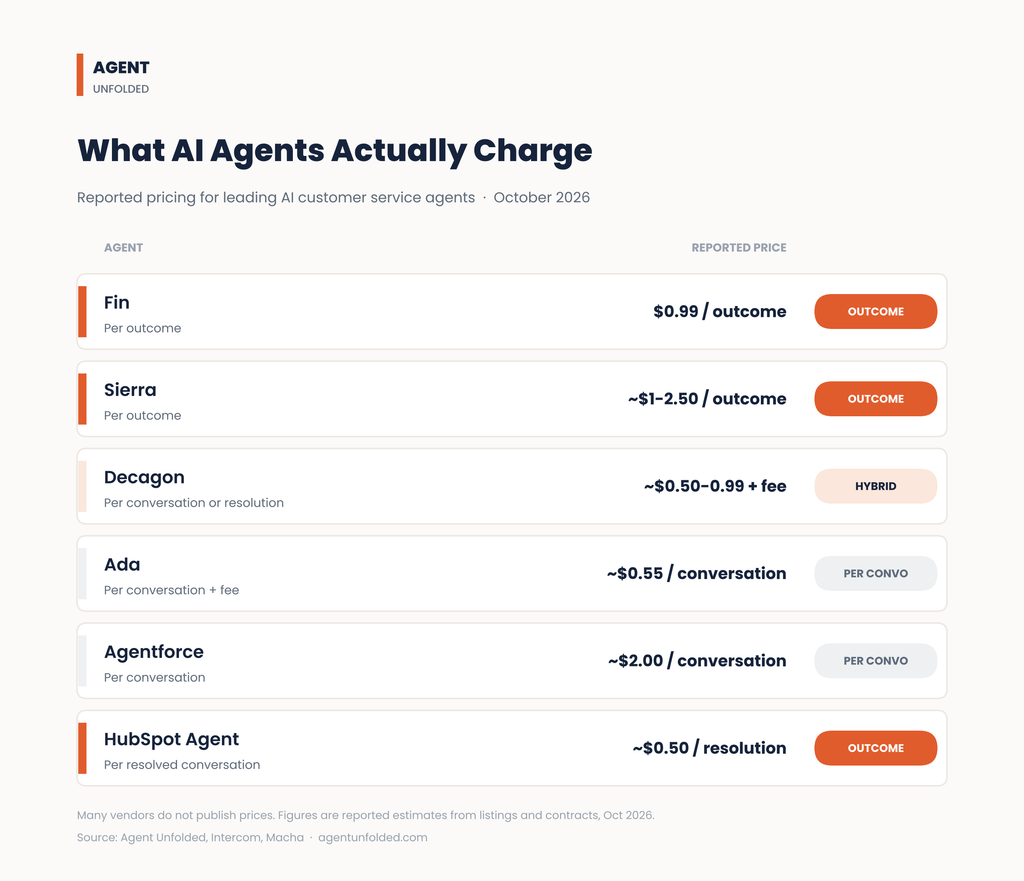
| Agent | Pricing model | Reported price | Notes |
|---|---|---|---|
| Fin (Intercom, now Salesforce) | Per outcome | $0.99 per outcome | No per seat fee required. Fin Voice at $1.99 per voice outcome. |
| Sierra | Per outcome | ~$1 to $2.50 per outcome | Custom enterprise deals. Est. platform from $150K/yr plus setup. |
| Decagon | Per conversation or per resolution | ~$0.50 to $0.99 plus platform fee | Chosen at signing. Reported platform fee around $50K/yr. |
| Ada | Per conversation plus platform fee | ~$0.55 per conversation | Reported floor around $30K/yr. |
| Salesforce Agentforce | Per conversation | ~$2.00 per conversation | Charged whether or not the issue is resolved. |
| HubSpot Customer Agent | Per resolved conversation | ~$0.50 per resolution | Price cut in April 2026. |
Prices are reported figures as of October 2026 and can change. Where a vendor does not publish pricing, the number is a public estimate.
What is outcome based pricing for AI agents?
Outcome based pricing means you pay only when the agent delivers a defined result. For a support agent, that result is usually a resolved ticket. If the agent fails or passes the case to a human, you pay nothing for that interaction. Fin by Intercom made this model popular at $0.99 per resolution. The appeal is simple. Your cost tracks the value you get, not the number of seats you buy.
Per seat vs per resolution: which is cheaper?
It depends on volume and how well the agent performs. Per seat pricing is predictable but does not scale with results, so you pay the same whether the agent solves one ticket or a thousand. Per resolution pricing scales with value, so a high performing agent can be cheaper per unit of work, but costs rise with volume. For high volume support teams, per resolution usually wins because the agent handles work that would need many seats. For low volume use, a flat fee can be simpler and cheaper.
Why are AI agents moving to outcome based pricing?
AI agents are moving to outcome based pricing because it ties the vendor’s revenue to real results. Buyers do not want to pay per seat for software that is meant to replace seats. They want to pay for work done. This shift also builds trust, because the vendor only earns when the agent succeeds. The risk for vendors is that their income now depends on reliability, so a weak agent costs them directly.
Which AI agents charge per resolution or per outcome?
Fin by Intercom, Sierra, and HubSpot’s Customer Agent charge on a per outcome or per resolution basis. Decagon offers per resolution as one of two options. Salesforce Agentforce and Ada lean on per conversation pricing instead, where you pay for each conversation regardless of the result. The trend across the market is toward paying for outcomes, not activity.
How we track this list
We collect pricing from vendor pages, public cloud marketplace listings, and reported customer contracts. Many AI agent vendors do not publish prices, so some figures are estimates and we label them as reported. We focus on the pricing model first, since that is stable, and treat specific prices as a guide. We review this page as vendors update their terms.
Frequently asked questions
AI customer service agents are often priced per outcome or per resolution, with reported rates from about $0.50 to $2.00 per unit, plus a possible yearly platform fee. Many enterprise agents use custom pricing and do not publish rates.
The most common models are per outcome and per resolution, where you pay when the agent solves something. Per conversation and per seat pricing are still used, but the market is shifting toward paying for results.
Outcome based pricing means you pay only when the agent reaches a defined result, such as a resolved support ticket. You pay nothing when it fails or hands the case to a human.
For high volume work, per resolution is often cheaper because one agent handles work that would need many seats. For low volume use, a flat per seat fee can be simpler and cost less.
Many do not. Fin and HubSpot publish clear rates, but Sierra, Decagon, and Ada use custom pricing, so public figures are estimates from listings and reported contracts.