
Decagon and Sierra are the two most valuable pure-play AI customer service companies, and they sell the same promise from different angles. Both build agents that talk to your customers, take real action in your systems, and resolve issues without a human. The short version is scale versus focus. Sierra is the broader, better-funded leader built for the whole customer lifecycle. Decagon is the high-volume resolution specialist built for deep measurement.
Choose Sierra if you want a branded agent acting across support, sales, and retention. Choose Decagon if you run high support volume and want tight analytics and control. This guide compares the two on funding, product, resolution, and price. It is part of our guide to AI agents for customer service.
Decagon vs Sierra at a glance
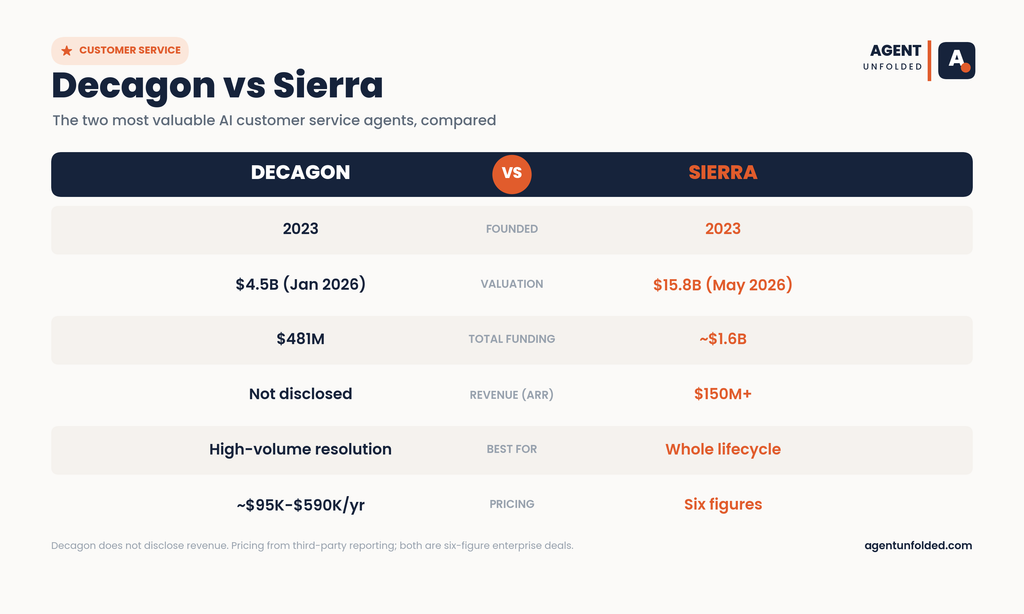
| Decagon | Sierra | |
|---|---|---|
| Founded | 2023 | 2023 |
| Founders | Jesse Zhang, Ashwin Sreenivas | Bret Taylor, Clay Bavor |
| Valuation | $4.5B (Jan 2026) | $15.8B (May 2026) |
| Total funding | $481M | ~$1.6B |
| Revenue (ARR) | Not disclosed | $150M+ |
| Best for | High-volume resolution and analytics | A branded agent across the lifecycle |
| Architecture | Sits on top of your helpdesk | Sits on top of your systems |
| Pricing | ~$95K to $590K per year | Six figures per year |
The two companies
Sierra is the market leader. It was founded in 2023 by Bret Taylor, the former co-CEO of Salesforce and current OpenAI chair, and Clay Bavor, a longtime Google executive. That pedigree helped it raise fast and land large enterprises early. It now says more than 40 percent of the Fortune 50 use its platform.
Decagon is the closest challenger. It was founded the same year by Jesse Zhang and Ashwin Sreenivas, and moved quickly from stealth to a multibillion-dollar valuation. Its focus is narrower and sharper: resolve high volumes of support interactions and give leaders deep visibility into how the agent performs. You can read the full story in our Decagon profile.
Funding and valuation
Sierra is far ahead on money. It raised $950 million in May 2026 at a $15.8 billion valuation, bringing its total to around $1.6 billion. Decagon has raised $481 million and reached a $4.5 billion valuation after tripling its worth in under six months.
The gap is real, but so is Decagon’s momentum. Sierra crossed $150 million in annual recurring revenue in its third year, a figure Decagon has not publicly matched or disclosed. On the numbers we can see, Sierra is the bigger business, and Decagon is the faster-rising challenger.
Product and approach
This is where the two really differ.
Sierra is built for breadth. Its agents act across the whole customer relationship, not just support, covering sales and retention too, and they carry a company’s brand voice. Sierra is strongest when the agent needs to sit above many systems and take action across the full customer lifecycle.
Decagon is built for depth in support. It leans hard into measurement, offering analytics, simulations, cross-channel memory, and quality monitoring across large conversation volumes. Its Agent Operating Procedures let support teams shape agent behavior in plain language, and it adds guardrails and tamper-protected audit logs. Decagon suits teams that want to run support at scale and see exactly how the agent is doing.
Both sit on top of an existing helpdesk like Zendesk or Salesforce rather than replacing it.
Resolution and measurement
Both advertise strong resolution rates, with Sierra citing customer-specific figures in the 70 to 90 percent range. The honest caveat applies to both: companies measure resolution differently and most numbers are self-reported, so compare how each defines a resolved case, not just the headline percentage.
Decagon’s edge is that measurement is central to its product. If proving and tuning agent performance matters to your team, its analytics and QA tooling are a real differentiator.
Pricing
Neither company publishes prices, and both sit in the six-figure band. Third-party data puts Decagon roughly between $95,000 and $590,000 per year depending on volume, with Sierra in a similar range. Both are enterprise purchases with sales-led deals and no free tier. Model your real deflectable volume before signing, since that is what determines the true cost.
Which should you choose?
Pick Sierra if you want the established leader and a branded agent that works across support, sales, and retention. Its scale, backing, and Fortune 50 traction make it the safe institutional choice.
Pick Decagon if support volume is your focus and you want deep measurement and control. Its analytics, simulations, and QA make it strong for high-growth teams that treat support performance as a number to optimize.
Agent Unfolded take
This is not a case of one winner. Sierra is ahead on funding, revenue, and breadth, and it is the default answer for a large enterprise picking a single leader. But Decagon’s focus is a real strategy, not a weakness. By owning high-volume resolution and measurement, it has carved out a defensible position next to a much larger rival.
The risk is the same for both. Incumbents like Salesforce and Zendesk are adding agents to tools these companies already sit on top of, and large firms like Klarna have shown it is possible to build in-house. Both Decagon and Sierra need their agents to stay reliable as they take on more complex work. Watch resolution quality on hard cases, not demos, because that is where the market will be won.
Frequently asked questions
Sierra is a broader, better-funded platform built for a branded agent across support, sales, and retention. Decagon is a high-volume support specialist focused on autonomous resolution with deep analytics and measurement.
Sierra is bigger by funding and valuation, at around $1.6 billion raised and a $15.8 billion valuation, with more than $150 million in ARR. Decagon has raised $481 million at a $4.5 billion valuation and does not disclose revenue.
Sierra is more valuable, at $15.8 billion as of May 2026, compared with Decagon at $4.5 billion as of January 2026.
Decagon is built for high-volume support, with strong analytics, simulations, and quality monitoring. Sierra also handles scale but is designed for a broader role across the customer lifecycle.
Neither publishes pricing. Both are six-figure annual enterprise purchases, with third-party estimates putting Decagon roughly between $95,000 and $590,000 per year and Sierra in a similar band.