
AI agents are moving into healthcare fast. The main categories are AI medical scribes, patient voice agents, clinical evidence tools, operations agents, and revenue cycle agents. The leaders include Abridge in scribes, Hippocratic AI in patient voice, OpenEvidence in clinical evidence, and Commure in operations. This page maps the field and the companies in each part of it. We update it as the market moves.
A healthcare AI agent does real work, not just answers. It can write a clinical note during a visit, call a patient to check on care, search medical evidence for a doctor, or process a billing code on its own. It is part of our guide to the agentic AI landscape.
What is an AI agent in healthcare?
A healthcare AI agent is software that completes a clinical or administrative task on its own, with a human in the loop for safety. It is different from a diagnostic model that only makes a prediction. An agent takes action. It drafts the note, places the call, pulls the evidence, or submits the code. The best ones are built to keep a clinician in control, because the cost of a mistake in healthcare is high.
The main categories of healthcare AI agents
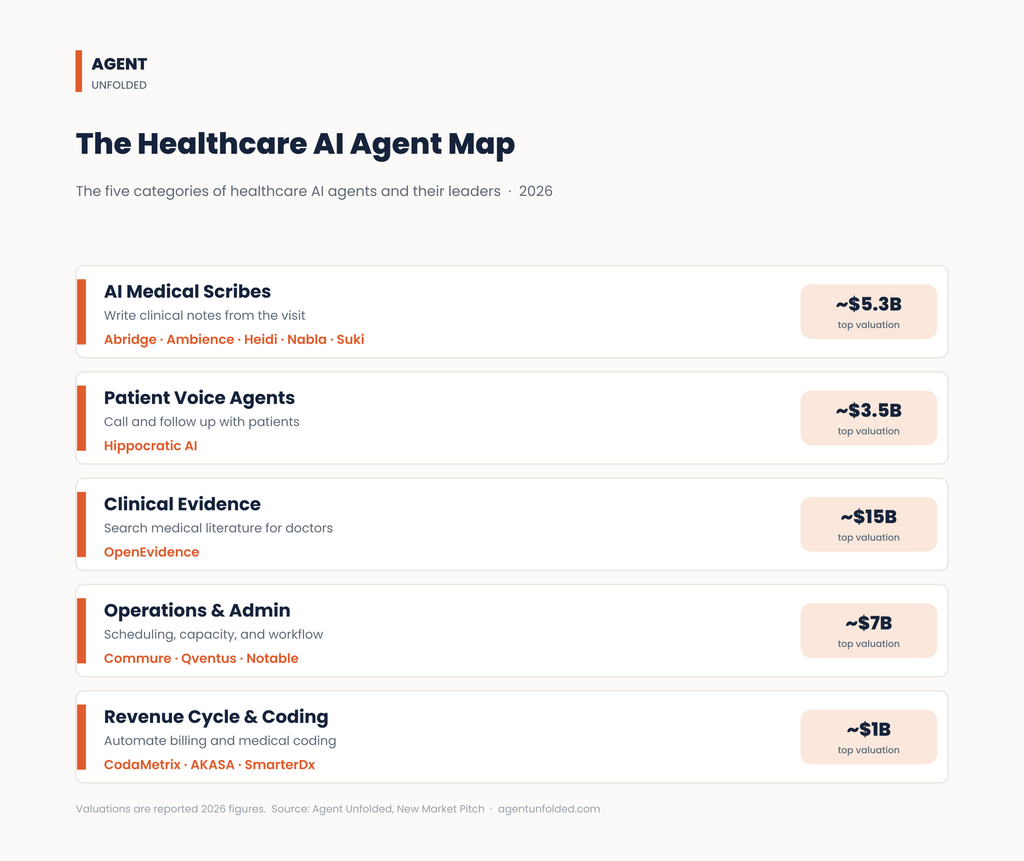
Healthcare AI agents fall into five main groups.
- AI medical scribes: Write clinical notes from the visit conversation. Leaders: Abridge, Ambience, Heidi, Nabla, Suki.
- Patient voice agents: Call and talk to patients for outreach and follow up. Leader: Hippocratic AI.
- Clinical evidence and decision support: Help doctors search medical literature and answer clinical questions. Leader: OpenEvidence.
- Operations and admin agents: Handle scheduling, capacity, and workflow. Leaders: Commure, Qventus, Notable.
- Revenue cycle and coding agents: Automate medical coding and billing. Leaders: CodaMetrix, AKASA, SmarterDx.
AI medical scribes: the biggest category
AI medical scribes are the largest and most proven category of healthcare AI agents. They listen to the visit and write the clinical note, which saves doctors hours of typing and cuts burnout. Abridge is the clear leader, reported at around $5.3 billion after a $300 million Series E. Ambience Healthcare is valued near $1.25 billion. Heidi reached about $900 million after a $100 million Series C. Nabla and Suki are also strong, each in the hundreds of millions. This is where AI agents are doing the most real work in healthcare today.
Patient voice agents: Hippocratic AI leads
Patient voice agents call and talk to patients for non diagnostic tasks like outreach, medication reminders, and follow up. Hippocratic AI is the clear leader here, valued at about $3.5 billion. The company reports more than 250 million patient interactions as of August 2026. It is careful to avoid diagnosis and prescribing, which keeps its agents inside a safer zone. This category is a high conviction bet, because staffing shortages are real and these calls are expensive to make by hand.
Clinical evidence and decision support: OpenEvidence
OpenEvidence is the standout in clinical evidence. It is an AI research assistant that helps physicians search medical literature and answer questions about diagnoses and treatments. It reportedly reached more than two thirds of US physicians and is valued at about $15 billion, which makes it the most valuable healthcare AI agent company. Its scale shows how much doctors want fast, cited answers at the point of care.
Operations and admin agents
Operations agents handle the unglamorous work that keeps a health system running. Commure builds healthcare operations and revenue cycle AI and is valued at about $7 billion. Qventus automates surgical scheduling, operating room capacity, and patient flow, and reports strong results, such as hundreds of extra surgical cases per month at one health system. Notable automates healthcare workflows across the patient journey. These agents target cost and capacity, where the savings are easy to measure.
Revenue cycle and medical coding agents
Revenue cycle agents automate billing and medical coding, a huge and costly part of US healthcare. CodaMetrix runs autonomous medical coding across specialties like radiology and pathology, with customers that represent about $180 billion in annual net patient revenue. AKASA handles inpatient coding and revenue cycle work, covering roughly one in ten US inpatient discharges. SmarterDx focuses on hospital revenue integrity. This is a strong fit for agents, because the work is rule heavy and tied directly to money.
Why is healthcare a strong market for AI agents?
Healthcare is a strong market for AI agents because the paperwork is endless and staffing is short. Doctors spend hours on notes, systems lose money to coding errors, and patients wait on hold. Each of these is a clear, measurable task an agent can take on. The money reflects it. Healthcare AI agents have drawn some of the largest rounds in the sector, and the scribe category alone has produced several multibillion dollar companies.
What are the challenges for healthcare AI agents?
The hard part is trust, safety, and regulation. A mistake in healthcare can harm a patient, so agents must be accurate and must keep a human in control. Rules like HIPAA govern patient data, and the FDA regulates anything that looks like a medical device. This slows adoption, but it also raises the reward for companies that get it right. The leaders succeed by narrowing their agents to safer tasks, like writing notes or making non diagnostic calls, rather than making medical decisions.
Which healthcare AI agent is the most valuable?
OpenEvidence is the most valuable healthcare AI agent company, at about $15 billion. It is followed by Commure at about $7 billion and Abridge at around $5.3 billion. Hippocratic AI rounds out the top names at about $3.5 billion. These valuations show that investors see healthcare as one of the most promising markets for agents, despite the regulatory hurdles.
Frequently asked questions
AI agents in healthcare are software systems that complete clinical or administrative tasks on their own, with a human in the loop. Examples include AI scribes that write clinical notes, voice agents that call patients, and agents that handle medical coding.
Abridge is the most valuable and widely used AI medical scribe, reported at around $5.3 billion. Ambience, Heidi, Nabla, and Suki are other strong options in the ambient documentation category.
OpenEvidence is the most valuable, at about $15 billion. It is a clinical evidence search tool used by more than two thirds of US physicians.
The leading agents are built for safety, with a human in the loop and a focus on lower risk tasks like documentation and non diagnostic calls. They must follow rules like HIPAA, and anything acting as a medical device is regulated by the FDA.
They can write clinical notes, call patients for outreach and follow up, search medical evidence for doctors, schedule and manage hospital operations, and automate medical coding and billing.