Customer service is the deepest market for AI agents. The work is high volume, repetitive, and expensive, so an agent that resolves a case end to end has clear, measurable value. That is why the two most heavily funded pure-play agent companies outside the foundation model labs both sell customer service.
The leaders are Sierra and Decagon, with Parloa close behind in voice. Around them sits a wide field of specialists, helpdesk-native tools, and incumbents adding AI. This guide explains what these agents do, names the leaders in each category, covers pricing and resolution rates, and gives an honest look at where they fall short. It is part of our guide to the agentic AI landscape.
The leaders at a glance
| Company | Focus | Funding / valuation |
|---|---|---|
| Sierra | Branded autonomous agent across the customer lifecycle | ~$1.6B raised, $15.8B valuation |
| Decagon | High-volume autonomous resolution with deep analytics | $481M raised, $4.5B valuation |
| Parloa | Voice-first, strong in regulated industries | $560M+ raised, $3B valuation |
| Intercom Fin | AI agent with a native helpdesk built in | Part of Intercom |
| Ada | Omnichannel, multilingual deflection | ~$200M raised |
What customer service AI agents do
A customer service AI agent does more than answer a question. It resolves the whole interaction. It reads the customer’s account, understands the request, takes an action in the company’s systems, and closes the case, ideally without a human touching it.
The best agents work across chat, email, voice, and SMS. They remember past conversations, follow a company’s policies, and hand off to a human when they hit something they cannot solve. The shift underway is from chatbots that point people to help articles to agents that actually do the thing the customer asked for.
The main categories
Customer service agents fall into a few groups, and the right one depends on your existing stack.
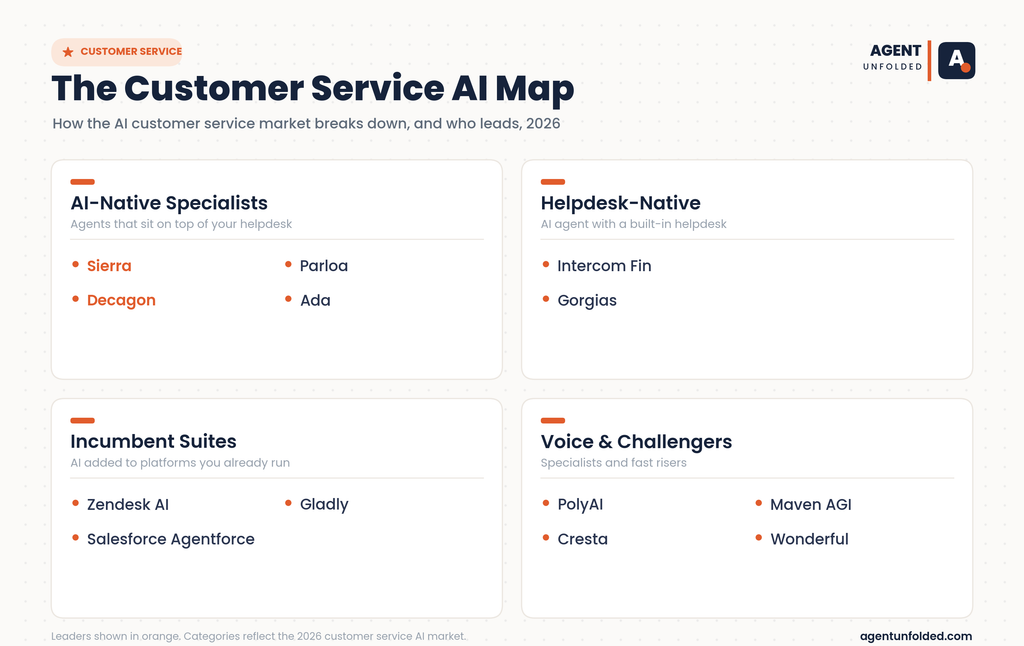
AI-native agent specialists. These build high-performance agents that sit on top of an existing helpdesk like Zendesk or Salesforce. Decagon, Sierra, Ada, and Parloa lead here. They offer the most advanced autonomous resolution, but they layer onto your current support system rather than replacing it.
AI-first platforms with a native helpdesk. Intercom Fin bundles the AI agent and the human support infrastructure in one system. That removes handoff friction and creates a single feedback loop between AI and human conversations. It fits teams that want the agent and the helpdesk from the same vendor.
Incumbent suites adding AI. Zendesk AI, Salesforce Agentforce, and Gladly bolt AI onto tools companies already run. They are the path of least resistance for existing customers, though the agents are often less capable than the specialists.
Build your own. Some large companies build in-house. Klarna is the well-known example. This makes sense only when support touches many complex systems and the team wants to own the architecture long term.
The leaders in depth
Sierra is the overall leader. Founded by Bret Taylor and Clay Bavor, it raised $950 million in May 2026 at a $15.8 billion valuation, bringing its total to around $1.6 billion. It crossed $150 million in annual recurring revenue in its third year, and says more than 40 percent of the Fortune 50 use it. Sierra fits teams that want a branded agent acting across support, sales, and retention.
Decagon is the closest challenger. It has raised $481 million and reached a $4.5 billion valuation. Decagon suits high-volume support teams that want autonomous resolution with close measurement, including analytics, simulations, and quality monitoring across many conversations.
Parloa has separated from the rest of the field. The German voice specialist raised a $350 million Series D that tripled its valuation to $3 billion, on the strength of logos like Microsoft and Booking.com. It reports more than $50 million in ARR and strong retention, with a real edge in regulated voice deployments in Europe.
Pricing
Pricing in this category has largely moved to outcomes, and the range is wide.
Intercom Fin charges about $0.99 per resolution on a $49 monthly base. Zendesk charges roughly $1.50 to $2.00 per automated resolution on top of its seats and an AI add-on. Salesforce Agentforce launched at $2.00 per conversation, billed whether or not the issue is resolved, which is a meaningful difference. Decagon and Sierra do not publish prices, and third-party data puts Decagon in the range of roughly $95,000 to $590,000 per year, with Sierra in a similar six-figure band. Ada and Forethought start in the tens of thousands.
The lesson is to model your real deflectable volume before signing anything, because the pricing model decides who captures the savings.
Resolution rates and the honest catch
Vendors advertise resolution rates of 70 to 90 percent, and by 2026 the top tier really does resolve most simple tickets on its own. But treat these numbers with care. Companies measure resolution differently, most figures are self-reported, and head-to-head tests are often run by the vendors themselves. Compare definitions, not just percentages.
The bigger catch is the gap between the demo and the deployment. The demo is genuinely impressive. Then you point the agent at your own help center and it answers with a policy you retired last year, or it cannot find an order because it lives in a system the agent was never wired into. The chat quality is rarely the problem. The problem is that the agent does not know how your company actually resolves things, and cannot finish the job in your systems. Integration depth and a clean knowledge base matter more than the model.
How to choose
Start with your stack. If you already run Zendesk or Salesforce, their AI or a specialist that sits on top may be fastest. If you use Intercom, Fin is the most direct path. If support is standardized and your knowledge base is clean, a platform will beat a custom build.
Then weigh volume and complexity. High-volume, measurement-focused teams lean toward Decagon. Teams that want a branded agent across the whole customer lifecycle lean toward Sierra. Voice-heavy or regulated operations should look hard at Parloa. Only build your own if your workflows are so complex and system-dependent that no platform fits.
Why it matters
Customer service is where AI agents are proving their value first, because the return is easy to measure. Vendors cite roughly $3.50 returned per dollar spent, rising toward 8x for the leaders. That clear ROI is why this is the most funded and most competitive corner of the agent market, and why the resolution promise, once a demo, is now real for simple work.
Frequently asked questions
The leading AI customer service agents in 2026 are Sierra and Decagon for enterprise autonomous resolution, Parloa for voice, Intercom Fin for teams wanting a built-in helpdesk, and Ada for multilingual, omnichannel support. The best fit depends on your stack and volume.
Pricing has largely moved to outcomes. Intercom Fin is about $0.99 per resolution, Zendesk and Salesforce charge roughly $1.50 to $2.00 per resolution or conversation, and enterprise specialists like Decagon and Sierra run into six figures a year with no public pricing.
Top-tier agents advertise 70 to 90 percent resolution on suitable workloads. Treat these figures with care, since companies measure resolution differently and most numbers are self-reported.
Buy a platform if your support workflow is standard and already fits a helpdesk or CRM. Build a custom agent only if your workflow depends on many systems, proprietary data, or complex escalation, and you want to own the architecture long term.
Sierra is the larger, more established leader and suits branded agents across the whole customer lifecycle. Decagon suits high-volume teams that want autonomous resolution with deep analytics and measurement. Both are top-tier, so the choice depends on your needs.