
Harvey and CoCounsel are two of the most established legal AI platforms, and they take very different paths. The short version is breadth versus depth. Harvey is a broad, agentic platform for drafting, diligence, and firm-wide legal work. CoCounsel is Thomson Reuters’ legal AI, grounded in Westlaw and Practical Law for research-first teams.
Choose Harvey for wide-ranging agentic work across a firm. Choose CoCounsel for authoritative, cited legal research, especially if you already use Westlaw. This guide compares how they work, what they cost, and which firms each one fits. It is part of our guide to AI agents for legal work.
Harvey vs CoCounsel at a glance
| Harvey | CoCounsel | |
|---|---|---|
| Owner | Independent, venture-backed | Thomson Reuters |
| Best for | Drafting, diligence, workflows | Verified legal research |
| Grounding | Custom-trained on firm data plus frontier models | Westlaw and Practical Law content |
| Standout | Agentic breadth and M&A diligence | Cited, verifiable research |
| Pricing | ~$1,000 to $2,000 per seat, not published | ~$225 per seat plus Westlaw |
| Fits | Large firms | Westlaw-ecosystem firms of any size |
The core difference
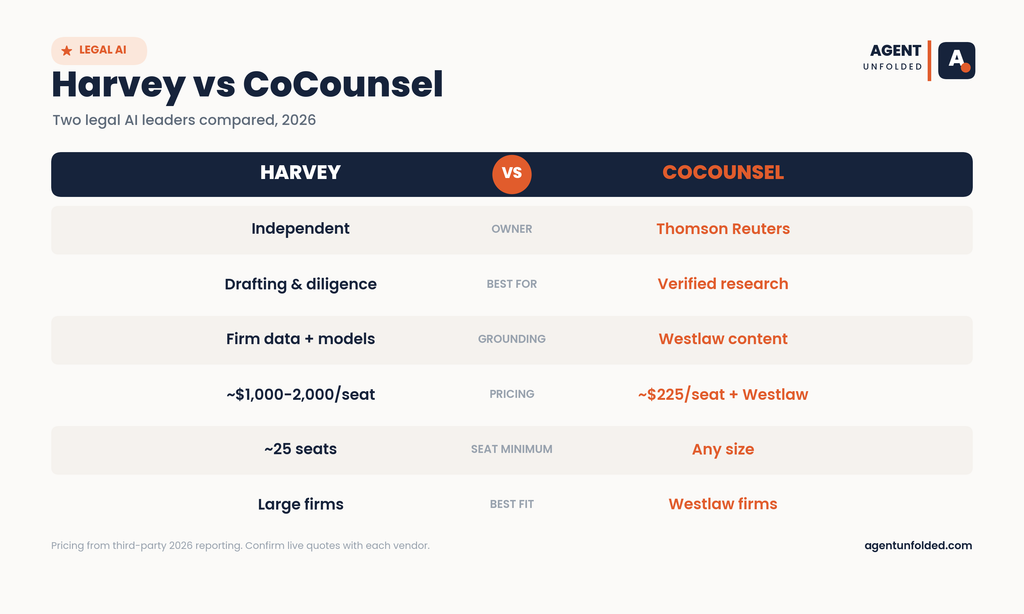
The split comes down to what each tool is built around.
CoCounsel grounds its answers in Thomson Reuters’ own legal content. Every case it cites actually exists in the Westlaw database, which is how it avoids the made-up citations that plague general AI. If your daily job is finding and citing controlling authority, that grounding is hard to beat.
Harvey is a standalone platform built on frontier models, fine-tuned on legal data and trained further on a firm’s own work. It is built for breadth. Its Agents run complex legal work end to end, and products like Vault handle bulk document analysis and contract review. If your job is drafting, diligence, and running workflows across many documents, Harvey covers more ground.
Research and citations
CoCounsel wins on research. Its Deep Research feature builds multi-step research plans, and its answers come back with verified citations from Westlaw and Practical Law. For a research-heavy practice, that is the whole point.
Harvey does research too, but its strength is applying AI across a firm’s own documents and workflows rather than leaning on a proprietary case-law database. The trade-off is control. With Harvey you are less dependent on a single content vendor. With CoCounsel you gain verified citations but tie your AI to the Thomson Reuters ecosystem.
Drafting and agentic work
Harvey wins on drafting and breadth. It handles contract review, multi-step diligence, and firm-wide workflows, and it learns a firm’s templates and preferences over time. Its due diligence chains are more sophisticated, which suits large transactional and litigation teams.
CoCounsel handles drafting and document work as well, but its workflow is more fragmented. Users often switch between a Word add-in for drafting and a separate web portal for multi-document analysis. Its edge is the research layer underneath, not the breadth of the platform.
Pricing
CoCounsel has clearer pricing, but a real catch. The CoCounsel document layer runs around $225 per user per month, but it does not include case-law search on its own. That requires a Westlaw subscription underneath, which pushes the real cost past $400 per seat, and often to around $500 to $640 for a solo on the full bundle. For firms already on Westlaw, it is a logical add-on. For firms outside that ecosystem, the total cost of entry is steep.
Harvey does not publish pricing. Third-party 2026 reporting puts it at roughly $1,000 to $2,000 per seat per month for mid-market firms, dropping toward $100 to $300 per seat at large-firm scale, usually with a seat minimum around 25 and an annual commitment. That structure is built for large firms. Always confirm current quotes with each vendor, since these numbers come from third-party reporting and change often.
Which should you choose?
Pick CoCounsel if research is your core need and you already live in Westlaw. The verified citations and gentle learning curve make it a natural fit for research-first teams.
Pick Harvey if you want a broad, agentic platform for drafting, diligence, and firm-wide workflows, and you have the budget and scale to match. It is the stronger choice for large firms that do not want to be locked into one content vendor.
If you are a solo lawyer or a very small firm, both may price you out. In that case, start with our guide to the best legal AI for solo lawyers instead.
Frequently asked questions
Harvey is a broad, agentic legal AI platform for drafting, diligence, and firm-wide workflows, built on custom-trained models. CoCounsel is Thomson Reuters’ legal AI, grounded in Westlaw and Practical Law for verified legal research.
CoCounsel is stronger for research. It grounds every answer in Westlaw and Practical Law and returns verified citations, which reduces the risk of fabricated case law.
CoCounsel is generally cheaper to enter, at around $225 per seat plus a required Westlaw subscription. Harvey is reported at roughly $1,000 to $2,000 per seat per month for mid-market firms, with a seat minimum.
Not really. As of 2026 CoCounsel is tied to the Westlaw ecosystem, so the practical cost is the Westlaw subscription plus the CoCounsel add-on.
Both are priced and structured for larger firms. Small firms and solo lawyers are usually better served by more affordable, self-serve legal AI tools built for their scale.