The best tool for preparing and reviewing contracts for legal teams depends on how your team works. There is no single winner. Spellbook is best for drafting inside Microsoft Word. Robin AI is best for high volume incoming contracts. Ironclad is best for in-house contract lifecycle management. Luminance is best for enterprise due diligence. Harvey is best for large firms handling complex matters.
This guide compares the leading tools honestly, with what each one does well, what it does not, and who it fits. It covers pricing signals, a decision framework, and the accuracy risks every legal team should know. It is part of our guide to AI agents for legal work.
Quick picks by use case
- Best for in-Word drafting: Spellbook
- Best for high-volume review: Robin AI
- Best for in-house lifecycle management: Ironclad
- Best for enterprise M&A and diligence: Luminance
- Best for large firms and complex work: Harvey
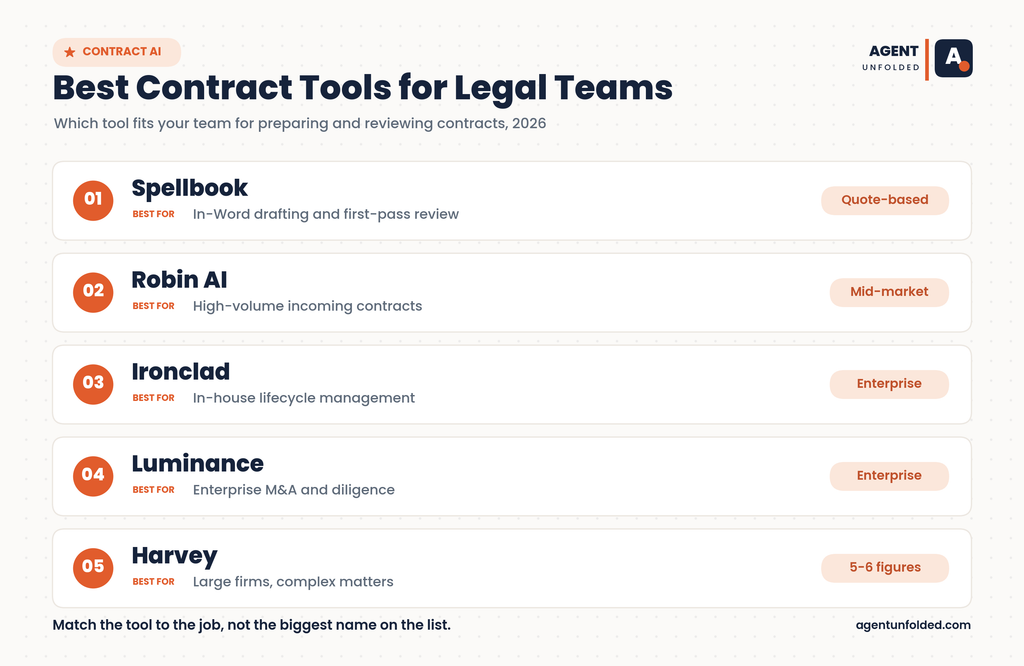
Comparison at a glance
| Tool | Best for | Key strength | Pricing |
|---|---|---|---|
| Spellbook | In-Word drafting and first-pass review | Works inside Microsoft Word | Quote-based |
| Robin AI | High-volume incoming contracts | Playbook redlining at a mid-market price | Mid-market, quote |
| Ironclad | In-house contract operations | Full lifecycle and repository | Enterprise, quote |
| Luminance | Enterprise M&A and diligence | Legal-grade agents across large portfolios | Enterprise, quote |
| Harvey | Large firms, complex matters | Multi-document synthesis at scale | Enterprise, 5 to 6 figures |
Spellbook
Spellbook is a Microsoft Word add-in that drafts, reviews, and redlines contracts inside the document you are already in. A lawyer can highlight a clause, ask for a review against standard practice, or generate alternative language without leaving Word. It is built on top of GPT and Claude and reports about 85 to 90 percent accuracy on commercial agreements.
Best for: transactional lawyers and small teams who draft in Word all day.
The catch: the price can feel steep for solo users, and a Word add-in is not built to run a large M&A data room with hundreds of documents.
Robin AI
Robin AI is built for the volume of contract work most transactional teams handle, like NDAs, master service agreements, vendor deals, and employment contracts. Its strength is playbook based redlining. It reviews incoming contracts against your standard positions and marks them up quickly.
Best for: small and mid-size teams reviewing a steady stream of incoming contracts.
The catch: it is aimed at standard, high volume work rather than the most complex bespoke transactions.
Ironclad
Ironclad is a contract lifecycle management platform. It is built for in-house legal operations, covering contract creation, approval workflows, and the central repository. It manages contracts from draft to signature in one place, with AI Assist layered on top.
Best for: in-house legal teams that want to manage the whole contract process, not just review.
The catch: it is a legal operations platform, not a law firm review tool, and the AI features are metered on top of the base cost.
Luminance
Luminance uses proprietary legal-grade agents to handle drafting, negotiation, analysis, and compliance across large contract portfolios. It grew up in M&A due diligence and now positions itself as an enterprise’s central memory for contracts, enforcing playbook consistency at scale.
Best for: enterprise legal operations and general counsel teams managing high volumes.
The catch: its focus on enforcing standards can feel restrictive for teams that want flexible drafting, and it is over-scoped for small firms.
Harvey
Harvey is an enterprise legal AI platform used by large firms and in-house departments. For contracts, its strength is multi-document synthesis across complex, high-value matters, backed by custom playbooks and enterprise procurement.
Best for: AmLaw 100 firms and large legal departments with complex needs and a real budget.
The catch: it is priced for scale, often in the five to six figure range per year, which is more than most small teams need.
How to choose
Match the tool to the job, not to the biggest name on the list. A due diligence engine that ingests thousands of contracts is overkill and overpriced for a lawyer reviewing a handful of agreements a week. A slick Word add-in will not run an M&A data room.
Work through a few questions. What do you draft and review most, and in what volume? Where does the work happen, in Word or in a separate platform? Do you need review only, or the full lifecycle from draft to signature and storage? What is the real budget, including any content or platform the tool sits on top of?
For most solo and small teams, Spellbook or Robin AI cover the ground at a sensible price. For in-house operations, Ironclad. For enterprise diligence, Luminance or Harvey.
How much time and money it saves
The savings are the reason this market exists. Manual contract review averages about 92 minutes per contract, and AI cuts that to roughly 22 minutes. That is a 76 percent reduction, and it can free up hundreds of hours per lawyer each year.
The cost math is just as clear. Lawyers bill anywhere from $100 to $500 an hour, and a single NDA or vendor agreement can take two to four hours to review by hand. Cutting that time down flows straight to the bottom line.
The accuracy and security catch
AI contract tools are fast, but they are not a substitute for a lawyer’s judgment. General models can miss context or invent terms, so the human stays responsible for what gets signed. Treat these tools as a strong first pass, not the final word.
Security matters just as much. Confidential contracts should only go into tools with clear data handling. Enterprise platforms like Harvey, Luminance, and Ironclad maintain strict data isolation and SOC 2 compliance, and Spellbook states that documents are not stored or used for training. Always confirm a vendor’s data practices before uploading sensitive material, and avoid general tools like ChatGPT for confidential legal work.
Frequently asked questions
It depends on the team. Spellbook is best for drafting and review inside Word, Robin AI for high volume incoming contracts, Ironclad for in-house lifecycle management, Luminance for enterprise diligence, and Harvey for large firms with complex work.
AI can review standard contracts quickly and catch common issues, with leading tools reporting around 85 to 90 percent accuracy on commercial agreements. It works best as a first pass, with a lawyer verifying the result before signing.
Ironclad is often the best fit for in-house teams because it manages the full contract lifecycle, from creation and approval to storage. Robin AI is a strong choice for teams focused on reviewing incoming contracts.
Most do not publish prices and route buyers to a quote. Lighter tools for small teams are relatively affordable, while enterprise platforms can run from tens of thousands into six figures a year.
AI cuts contract review from about 92 minutes to roughly 22 minutes on average, a 76 percent reduction, which can free hundreds of hours per lawyer each year.
It depends on the tool. Enterprise legal platforms offer strict data isolation and SOC 2 compliance, and some tools promise not to store or train on your documents. Confirm each vendor’s data handling, and avoid general consumer AI tools for confidential work.