
Legal work is one of the strongest markets for AI agents. The work is heavy on documents and research, and firms bill by the hour, so any tool that saves time has clear value. In 2026, AI agents are handling real legal tasks, from research and contract review to drafting and diligence.
The market leaders are Harvey and Legora, both enterprise platforms valued in the billions. Around them sits a wide field of tools for research, contracts, litigation, and specialized work. This guide explains what legal AI agents do, names the leaders in each category, and covers how to choose and what risks to watch. It is part of our guide to the agentic AI landscape.
The leaders at a glance
| Company | Focus | Valuation |
|---|---|---|
| Harvey | Enterprise research, drafting, diligence | $11B |
| Legora | Collaborative enterprise platform | $5.6B |
| Clio | Practice management with AI | $3B |
| EvenUp | Personal injury demand letters | ~$1B |
| CoCounsel (Thomson Reuters) | Research grounded in Westlaw | Incumbent |
| Spellbook, Robin AI, Luminance | Contract drafting and review | Private |
What legal AI agents do
Legal AI agents take on the parts of legal work that are heavy on text and process. The main tasks fall into a few groups.
Legal research means finding relevant case law and answering legal questions with citations. Contract review and drafting covers reading, editing, and writing agreements. Document review and diligence means combing through large sets of documents to find key issues. Litigation and e-discovery covers finding and analyzing evidence for a case. Some tools also handle narrow, specialized work, like writing personal injury demand letters.
The best tools do more than answer. They take a goal and complete the task, which is what makes them agents rather than chatbots. For a fuller explanation of that difference, see our guide on AI agents vs chatbots vs copilots.
The main categories and their leaders
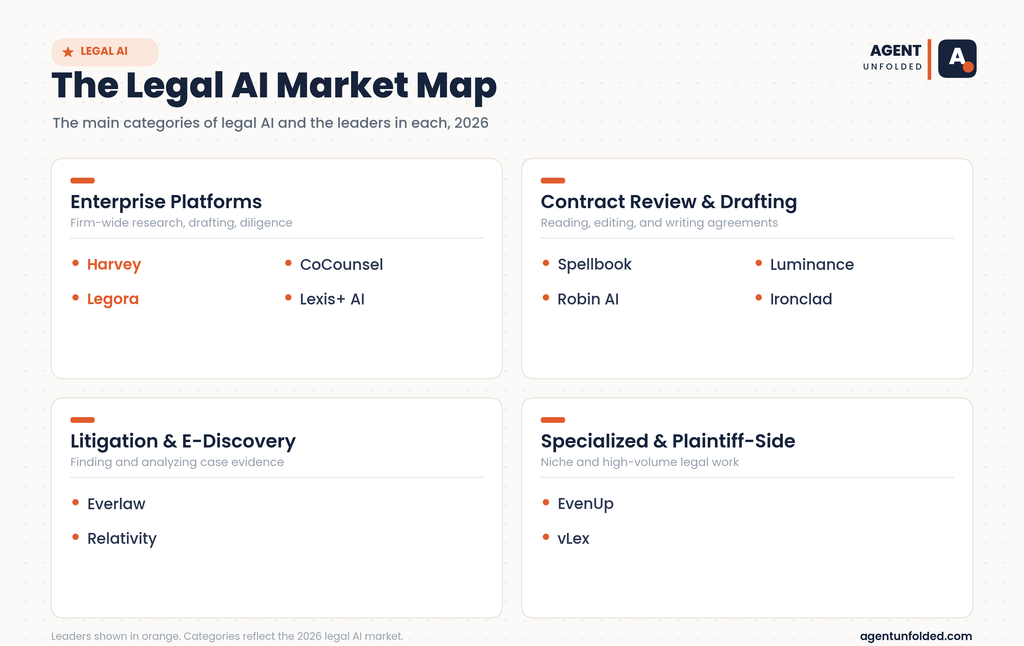
Enterprise platforms. These are the firm-wide systems that a whole firm adopts. Harvey and Legora lead this tier. Both handle research, drafting, and diligence, and both sell to large firms and in-house teams. Thomson Reuters CoCounsel and LexisNexis with its Protege assistant are the incumbents, with research grounded in Westlaw and Lexis content.
Contract drafting and review. This is where much of the volume sits. Spellbook is the accessible option that works inside Word. Robin AI and Luminance handle high volumes of incoming contracts. Ironclad and LinkSquares own the contract lifecycle and repository.
Litigation and e-discovery. Everlaw and Relativity lead here, with AI built into the review platform. Both made generative review a standard feature in 2026, a sign that AI is becoming part of the litigation stack rather than a separate purchase.
Specialized and plaintiff-side. EvenUp built a strong business writing personal injury demand letters and is now valued around $1 billion. vLex focuses on research with a popular free tier.
Harvey vs Legora, the defining rivalry
The two leaders are locked in a close race. Harvey is the larger and more established. It was founded in 2022, makes more than $350 million in annual recurring revenue, and reached an $11 billion valuation in March 2026. Legora is the fast rising challenger, founded in 2023 in Sweden, valued at $5.6 billion, and growing quickly in the United States.
Both are also reportedly raising again at much higher valuations, Harvey near $15.5 billion and Legora above $10 billion. For a full breakdown of how they compare, see our Harvey vs Legora analysis.
Why it matters
The time savings are real and measurable. One analysis found that manual contract review averages about 92 minutes, and AI cuts that to roughly 22 minutes, a 76 percent reduction. Across a year, that can free up hundreds of hours per lawyer.
The money reflects the opportunity. The legal AI software market is expected to reach about $5.2 billion in 2026 and grow toward $40 billion by 2034. Investment in legal AI roughly doubled in a single year, and most new funding for legal startups now goes to AI companies. The prize is a slice of a legal services market worth hundreds of billions a year.
The risk to watch
Legal AI has a trust problem, and it is serious. General models can invent case law that does not exist. Courts have started to sanction lawyers who file briefs with fabricated citations. In one benchmark, nearly a quarter of graded answers cited or applied law that did not support the claim.
This is why grounding matters. The stronger tools use retrieval and citation checks to tie answers to real sources, and they show their work so a lawyer can verify it. No tool is safe to trust blind. The lawyer stays responsible for what gets filed, which is exactly why the best legal AI is built to be checked, not just believed.
How to choose
The right tool depends on the firm and the work.
Large firms doing firm-wide rollouts should look at Harvey or Legora as the platform, and run both through a bake-off, since the competition between them favors buyers right now. In-house legal teams focused on contracts should look at Ironclad or Spellbook. Small and mid-size firms often get the most value per dollar from Spellbook or a research tool like vLex or Lexis+ AI. Litigation-heavy practices should weigh Everlaw or Relativity.
One practical warning. Most enterprise tools do not publish prices and route buyers to a demo, with annual costs that can run from tens of thousands into six figures. Price the whole setup, not just the headline seat cost.
Frequently asked questions
The leading legal AI tools in 2026 are Harvey and Legora for enterprise work, CoCounsel and Lexis+ AI for research, Spellbook and Robin AI for contracts, and Everlaw and Relativity for litigation. The best fit depends on firm size and the type of work.
AI agents can research case law, review and draft contracts, comb through documents for diligence, and analyze evidence for litigation. The best ones complete these tasks rather than just answering questions, with citations a lawyer can check.
Not blindly. General AI models can invent case law, and courts have sanctioned lawyers for filing fabricated citations. The stronger legal tools reduce this risk with grounding and citation checks, but the lawyer stays responsible for verifying the work.
Most enterprise legal AI tools do not publish prices and route buyers to a demo. Annual costs typically run from tens of thousands of dollars into six figures for large firms. Smaller tools like Spellbook are far cheaper.
Harvey is larger and more established, with more revenue and deeper roots in top US firms. Legora is growing faster and is known for collaboration and deep integrations. The better choice depends on the firm’s needs.
One analysis found AI cuts contract review from about 92 minutes to roughly 22 minutes, a 76 percent reduction, which can free hundreds of hours per lawyer each year.