
The short answer is that it depends on the company. AI agent valuations are high, but they are not all the same. Some are backed by real, fast growing revenue. Others are priced on hype. Calling the whole field a bubble misses that split.
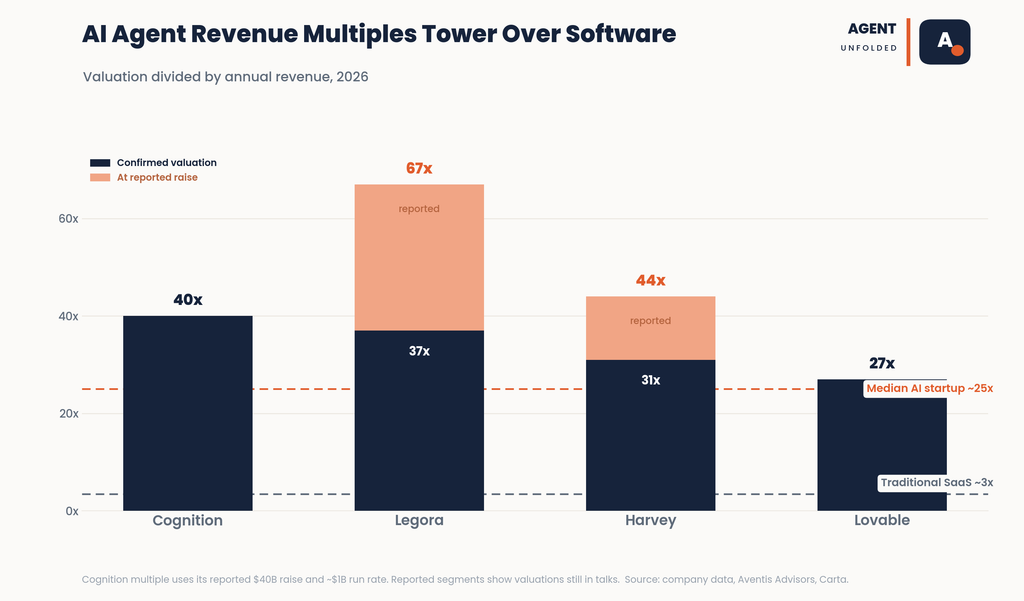
The leading agent companies now raise at 30 to 70 times their revenue. That is far above normal software, but they are also growing far faster than normal software. This article looks at the real multiples, the case for and against a bubble, and where the actual risk sits. It builds on our agentic AI landscape.
What the agent leaders actually trade at
| Company | Valuation | Revenue (ARR) | Revenue multiple |
|---|---|---|---|
| Cognition | $40B (reported) | ~$1B run rate | ~40x |
| Legora | $5.6B | ~$150M | ~37x |
| Harvey | $11B | ~$350M | ~31x |
| Lovable | $13.3B | ~$500M | ~27x |
At their reported new raises, the multiples climb higher. Harvey at a reported $15.5 billion would sit near 44 times revenue. Legora at a reported $10 billion would reach about 67 times. Those are steep numbers that leave little room for a stumble.
For context, the median AI startup trades around 20 to 30 times revenue in 2026. Foundation model companies average close to 37 times. Traditional software sits near 3 times. So agent companies are priced at a large premium to old software, but roughly in line with the rest of AI.
The case that it is not a bubble
The bull case starts with revenue. Unlike the dot com era, these companies have real, large, and fast growing sales. Cognition is approaching a $1 billion run rate. Lovable crossed $500 million in about 18 months. This is not vaporware.
Public markets have also already cooled. Software multiples are near their lowest since 2015. The high prices now sit mostly in private markets, where strategic and corporate money sets a floor that has little to do with normal venture math.
There are signs of discipline too. Foundation model multiples have compressed from the 60 to 100 times range down toward 15 to 50 times. Investors increasingly demand revenue numbers, not just model demos, before they write checks.
The case that it is a bubble
The bear case starts with a gap. Spending on AI infrastructure is running near $400 billion a year, while enterprise AI revenue is closer to $100 billion. That is a four to one gap between what is being spent and what is being earned.
The results inside companies are mixed. One McKinsey study found only 6 percent of companies see real profit impact from AI. An MIT study found that most organizations it looked at got no measurable return at all. If that adoption does not improve, the revenue growth these valuations assume may not arrive.
The mood among big names has cooled as well. Jeff Bezos has compared the moment to an industrial bubble. Sam Altman has warned that investors will overinvest and some will lose money. Surveys of fund managers show a majority now see AI stocks as bubble territory.
Where the real risk sits
The honest view is that the market has split in two. On one side are companies with real revenue and a moat, usually a data or workflow advantage that gets stronger with use. On the other side are thin wrappers that add a light layer on top of someone else’s model, and demo driven names priced on promise rather than sales.
The clearest froth is not in the companies resolving support tickets or shipping code. It is in places like AI robotics names trading near 400 times revenue on demos, and in app layer tools with no data or distribution edge. Those are the valuations most likely to break if the mood turns.
Agent Unfolded take
This is not a simple yes or no. The leading agent companies are expensive, but they are backed by real revenue growing at a pace old software never saw. That makes them very different from dot com shells with no sales.
The risk is not that agents are fake. It is that the prices assume near perfect execution for years. A company at 67 times revenue has to keep growing fast, hold off frontier models, and never stumble. Some will manage it. Many will not.
So the useful question is not whether AI agents are a bubble. It is which companies will grow into their price and which will not. The froth is real, but it is concentrated in thin wrappers and demo hype, not in the whole field. Watch revenue durability and moat, not the headline valuation.
Frequently asked questions
Not uniformly. Leading agent companies are priced high, at 30 to 70 times revenue, but many are backed by real, fast growing sales. The bubble risk is concentrated in thin wrappers and demo driven names, not the whole field.
Top AI agent companies trade at roughly 27 to 67 times revenue in 2026. For comparison, the median AI startup is around 20 to 30 times, and traditional software is near 3 times.
Investors are paying for very fast revenue growth, potential winner take most dynamics, and strategic capital that sets a high floor. The premium holds when a company has a real data or workflow moat.
The biggest risk is that the growth these prices assume does not arrive, either because enterprise adoption stalls or because frontier AI models absorb the simpler tasks that vertical agents handle today.
The highest risk sits with thin AI application wrappers that lack proprietary data or distribution, and with demo driven categories priced far above their actual revenue.