The terms chatbot, copilot, and AI agent get used as if they mean the same thing. They do not. The simplest way to tell them apart is by how much they do on their own. A chatbot answers. A copilot assists. An agent acts.
A chatbot responds to questions with information. A copilot works alongside a person and helps them finish a task, but the person stays in control. An AI agent takes a goal and completes the whole task by itself, making decisions and taking actions along the way. This guide explains each one, shows how to tell them apart, and gives clear examples. It is part of our guide to the agentic AI landscape.
Quick comparison
| Chatbot | Copilot | AI agent | |
|---|---|---|---|
| What it does | Answers questions | Helps a person in a task | Completes tasks on its own |
| Human role | Asks and reads the reply | Stays in control, approves steps | Sets the goal, agent executes |
| Autonomy | None | Low, it suggests | High, it acts and decides |
| Takes actions | No | Yes, with approval | Yes, independently |
| Example | FAQ bot, Siri | GitHub Copilot, Microsoft Copilot | Decagon, Devin, Cursor |
| Best for | Quick answers | Boosting productivity | Automating whole workflows |
The core idea: a spectrum of autonomy
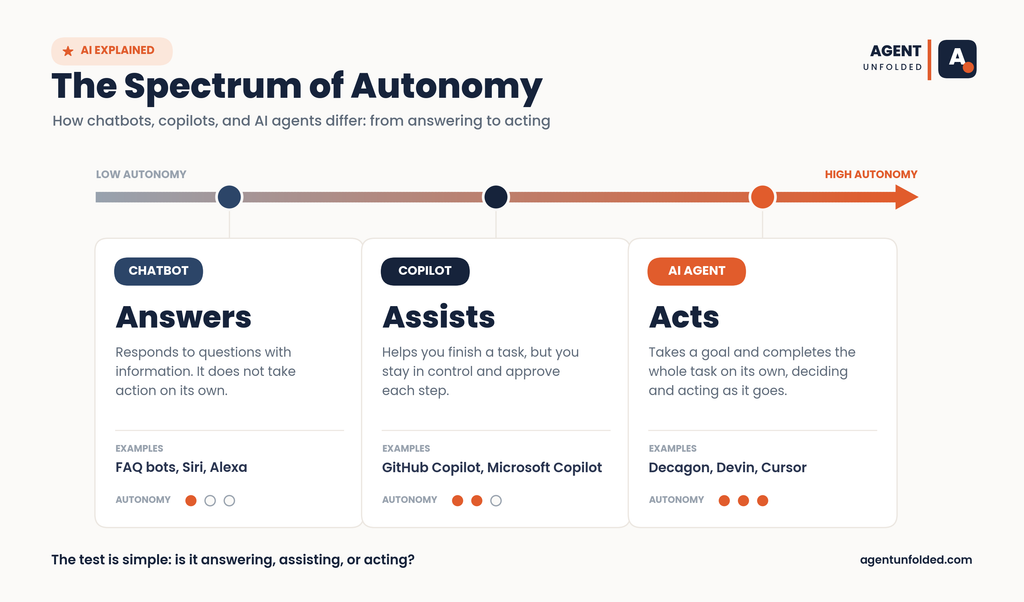
The three are not separate species. They sit on a line. At one end, the software only talks. At the other end, it does the work. Chatbots answer, copilots assist, and agents act.
As you move along that line, two things go up. The software takes on more of the task, and the human takes on less. That single shift, from talking to doing, is the whole story of why agents are such a big deal right now.
What is a chatbot?
A chatbot is software that holds a conversation and returns information. You ask a question, it gives an answer. That is the full loop.
Early chatbots followed fixed scripts and rules. Modern ones use large language models, so they sound natural and handle open questions. But the job is the same. A chatbot informs. It does not go off and do things in other systems. A support bot that answers “where is my order” is a chatbot. So are basic versions of voice assistants like Siri and Alexa.
What is a copilot?
A copilot is an AI assistant that works next to a person inside a task. It suggests, drafts, and speeds things up, but the human stays in the driver’s seat and approves what happens.
The name says it well. A copilot does not fly the plane alone. GitHub Copilot suggests code while a developer writes, and the developer accepts or rejects each suggestion. Microsoft Copilot drafts an email or summarizes a document, and the person decides what to do with it. The value is speed and support, not independence. The human is always in the loop.
What is an AI agent?
An AI agent takes a goal and completes the task on its own. It can plan the steps, use tools, access data, make decisions, and take actions with little or no human help.
This is the real leap. An agent does not just answer a question about a refund. It processes the refund. It does not just suggest code. It writes, tests, and ships it. Decagon runs full customer service interactions end to end. Devin, from Cognition, builds software as an autonomous engineer. Cursor helps write and change whole codebases. The person sets the goal, and the agent does the work.
How to tell them apart
There is a simple test. Ask what happens after the AI responds.
If it just gave you information, it is a chatbot. If it helped you do something but waited for your approval, it is a copilot. If it went and did the thing itself, it is an agent.
The key questions are whether it takes actions, whether it needs approval for each step, and who does most of the work. Chatbots take no actions. Copilots take actions with your sign off. Agents take actions on their own.
Why the difference matters
The difference is not just about words. It changes what the software is worth.
A chatbot saves a little time by answering faster. A copilot saves more by making a skilled person quicker at their job. An agent can replace whole chunks of work, which is why the savings are so much larger and why investors are pouring money into agent companies. It also raises the stakes. Software that only talks cannot do much harm. Software that acts on its own needs guardrails, oversight, and security, which is why agent governance has become its own market.
Where the lines blur
In practice, many products mix these modes. A tool might start as a chatbot, add copilot features, and later gain agent abilities. ChatGPT is a good example. It began as a chatbot, works as a copilot when it drafts or codes with you, and acts as an agent when it uses tools to complete a task on its own.
So the labels describe what the software is doing in a moment, not a fixed category it can never leave. The useful question is always the same. Is it answering, assisting, or acting?
Frequently asked questions
A chatbot answers questions and returns information. An AI agent goes further and completes tasks on its own, taking actions like processing a refund or writing code. Chatbots inform, agents act.
A copilot helps a person do a task and waits for their approval at each step. An AI agent takes a goal and completes the task on its own, with little or no human input. The difference is who stays in control.
ChatGPT can be all three. It started as a chatbot, acts as a copilot when it helps you write or code, and works as an agent when it uses tools to complete a task on its own.
GitHub Copilot is mainly a copilot. It suggests code while a developer works, and the developer approves each suggestion. It has added more autonomous, agent style features over time, but its core mode keeps the human in control.
Not better, different. Chatbots are the right tool for quick answers. Agents are the right tool for automating a full task. The best choice depends on whether you need information or completed work.
Examples of AI agents include Decagon for customer service, Devin from Cognition for software engineering, and Cursor for coding. Each takes a goal and does the work rather than only answering questions.