Collective has raised $100 million in new funding. The deal is a $40 million Series B plus a $60 million growth facility. General Catalyst, QED Investors, and Gradient Ventures led the equity round. Collective announced it on October 29, 2026.
Collective builds an AI native financial operating system for one person businesses. It calls itself an agentic financial OS. The platform handles the back office work of running a solo business, from forming the company to filing taxes, with workflows that run automatically in the background.
What does Collective do?
Collective is a financial platform built for what it calls Businesses of One. It covers the full back office in one place. That includes setting up the legal entity, such as an LLC, plus accounting, invoicing, payroll, tax preparation and filing, and business and health insurance. It also runs customer support that pairs a human team with AI.
The idea is to let a solo founder skip the patchwork of tools and advisors most small businesses stitch together. Collective says routine financial work runs on its own in the background, so the owner can focus on the actual business.
The round at a glance
| Detail | Info |
|---|---|
| Total new funding | $100 million |
| Equity round | $40 million Series B |
| Growth facility | $60 million |
| Valuation | Not disclosed |
| Date | October 29, 2026 |
| Lead investors | General Catalyst, QED Investors, Gradient Ventures |
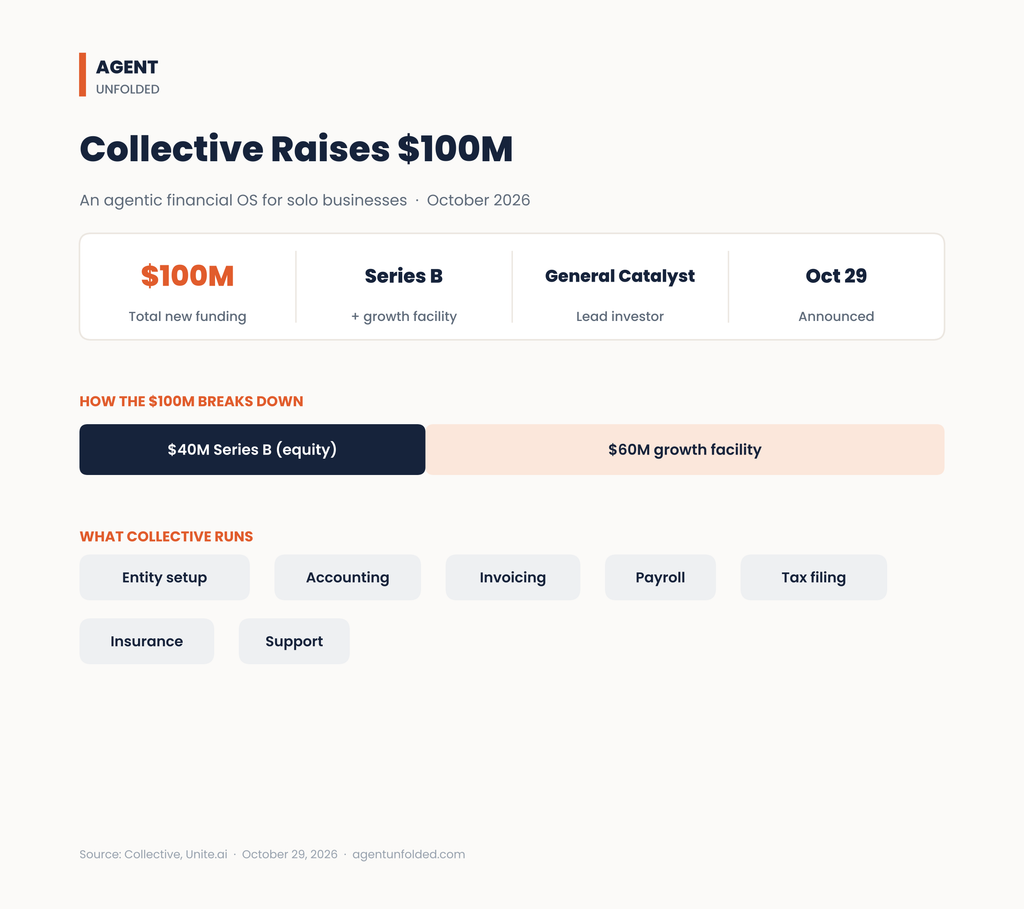
The $100 million comes in two parts. The $40 million Series B is equity. The $60 million is a growth facility from General Catalyst’s Customer Value Fund, set aside for customer acquisition and for building out banking and insurance features.
Who invested in Collective’s round?
General Catalyst, QED Investors, and Gradient Ventures led the Series B. Intuit Ventures, FT Partners, and SemperVirens also took part. The $60 million growth facility came from General Catalyst’s Customer Value Fund. Intuit’s involvement is worth noting, since Intuit owns QuickBooks and TurboTax, the tools many solo businesses use today.
How does Collective use AI agents?
Collective describes its product as an agentic financial operating system. Instead of a person doing each task, the platform runs financial workflows automatically in the background. Bookkeeping, tax steps, and filings are handled by the system, with people brought in where judgment is needed. Its support model is a mix of a human team and AI, rather than full automation.
Why does this round matter?
Solo businesses are a huge and underserved market. There are tens of millions of one person companies, and most juggle several tools and advisors to stay compliant. Collective is betting that an agent driven platform can do that work end to end at a fraction of the cost.
The funding structure is a signal too. Pairing a smaller equity round with a larger growth facility lets Collective fund customer acquisition without giving up more ownership. That is a sign of confidence in steady, repeatable growth.
What is next for Collective?
Collective plans to use the money to grow its customer base and expand into banking and insurance. The challenge is trust and accuracy. Tax and compliance work has little room for error, so the agentic system has to be reliable. Collective was co-founded by Hooman Radfar, who earlier co-founded AddThis, later bought by Oracle.
Frequently asked questions
Collective raised $100 million on October 29, 2026. It is made up of a $40 million Series B equity round and a $60 million growth facility.
General Catalyst, QED Investors, and Gradient Ventures led the round. Intuit Ventures, FT Partners, and SemperVirens also joined, and the growth facility came from General Catalyst’s Customer Value Fund.
Collective builds an agentic financial operating system for solo businesses. It handles entity formation, accounting, invoicing, payroll, tax filing, and insurance, with workflows that run automatically.
Collective calls its product an agentic financial OS. It runs financial workflows automatically in the background and pairs AI with a human team for support, rather than relying on full automation.
Collective was co-founded by Hooman Radfar, who previously co-founded AddThis, a company later acquired by Oracle.