
Most AI agents do not build their own brain. They run on a foundation model from Anthropic, OpenAI, Google, or another lab, and many use several at once. This page maps which models power the leading agents, so you can see at a glance who runs on Claude, who runs on GPT, and who built their own.
The short answer: most top agents are multi-model, Anthropic’s Claude is the single most common model underneath them, and a growing group is now training models of their own. This is a living reference, updated as agents switch models. It is part of our guide to the agentic AI landscape.
AI models behind the top agents at a glance
| Agent | Category | Models it runs on | Own model |
|---|---|---|---|
| Claude Code | Coding | Anthropic Claude | No |
| OpenAI Codex | Coding | OpenAI GPT | No |
| Cursor | Coding | Claude, GPT, Gemini, Grok, plus Composer | Composer |
| Devin | Coding | OpenAI, Claude, Gemini, plus SWE | SWE |
| GitHub Copilot | Coding | Claude, GPT, Gemini, and more | No |
| Lovable | App builder | Frontier models plus its own | Yes |
| Harvey | Legal | OpenAI, Anthropic, Google | No |
| Legora | Legal | Mainly Anthropic Claude | No |
| CoCounsel | Legal | Frontier models, Westlaw-grounded | No |
| Decagon | Customer service | OpenAI, Anthropic, Cohere | No |
| Sierra | Customer service | Multiple frontier models | No |
| Parloa | Customer service | OpenAI and others | No |
Do AI agents use one model or many?
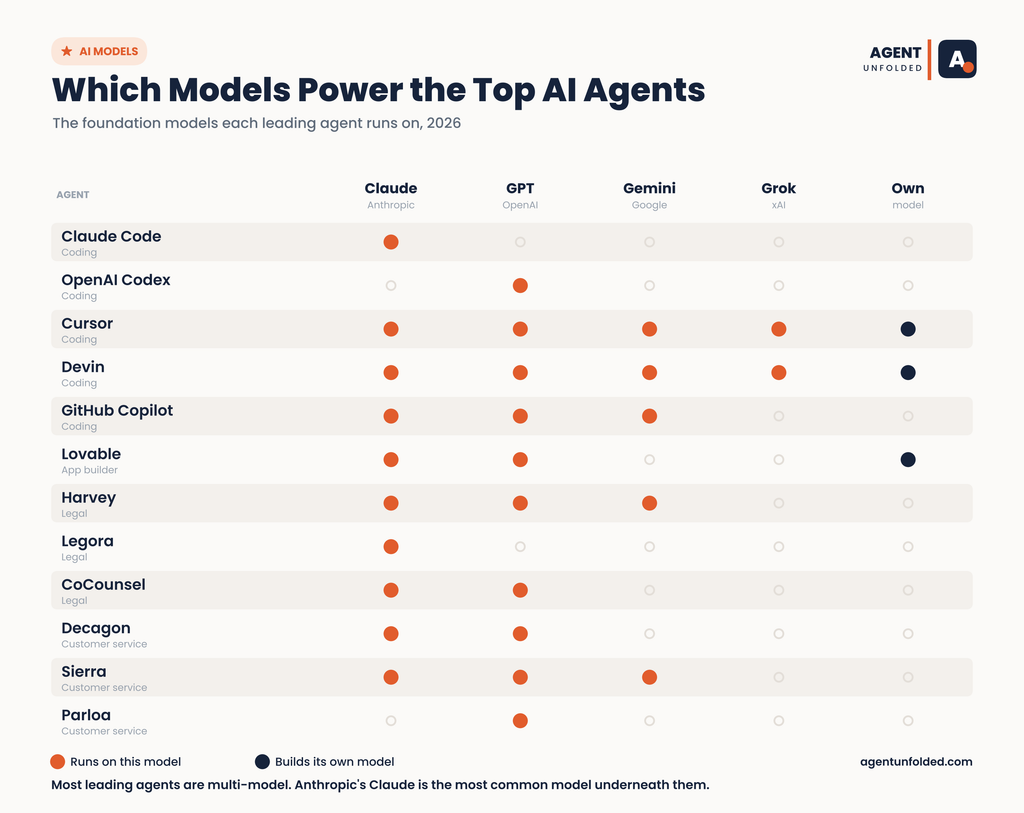
Most use many. The leading agents are model-agnostic, which means they route each task to whichever model handles it best. Decagon runs on OpenAI, Anthropic, and Cohere. Cursor lets you pick between Claude, GPT, Gemini, and Grok. Harvey draws on models from OpenAI, Anthropic, and Google.
There is a good reason for this. Models change fast, and no single one leads at everything. By staying model-agnostic, an agent can swap in a better model the week it ships, and avoid being locked to one lab’s pricing or outages. The agent’s real value is the layer on top, the tools, the data, and the workflow, not the raw model underneath.
Which AI models power AI agents, by category
Coding agents
Coding is where owning a model is most common. Cursor runs its own Composer model alongside Claude, GPT, Gemini, and Grok. Cognition’s Devin uses its own SWE model plus others. Claude Code runs on Anthropic’s own Claude, and OpenAI Codex on GPT. GitHub Copilot stays broad, offering Claude, GPT, Gemini, and dozens more.
Legal AI agents
Legal agents lean on frontier models with heavy grounding in legal data. Harvey uses OpenAI, Anthropic, and Google models fine-tuned on legal work. Legora runs mainly on Anthropic’s Claude. CoCounsel pairs frontier models with Thomson Reuters’ Westlaw content to keep answers cited and verifiable. See how two of them compare in our Harvey vs Legora piece.
Customer service agents
Customer service agents are almost all model-agnostic. Decagon uses OpenAI, Anthropic, and Cohere. Sierra draws on multiple frontier models and picks the best one per task. Parloa builds on OpenAI and others for its voice agents. The pattern is the same across the category: the model is a swappable part, and the company’s own data and workflow are the product.
AI agents that build their own models
A small but growing group is going further and training its own models. Cursor built Composer. Cognition built its SWE model for Devin. Lovable is developing its own model alongside the frontier ones it uses. OpenAI Codex runs on OpenAI’s own GPT by design.
The logic is cost and control. At scale, paying another lab per token gets expensive, and a custom model can be tuned for one job and run cheaper. Expect more of the best-funded agents to follow, especially in coding, where the volume is highest.
Which model is most common in AI agents?
Anthropic’s Claude shows up more often than any other model across serious agents. It powers Claude Code directly, is the main model behind Legora, and is one of the options inside Decagon, Harvey, Cursor, GitHub Copilot, and many more. OpenAI’s GPT is a close second and leads in several agents, with Google’s Gemini common as a third option. For most buyers, the takeaway is simple: the top agents give you access to the best models available, so the model is rarely the reason to pick one agent over another.
Frequently asked questions
Most top AI agents are multi-model and run on several at once. Anthropic’s Claude is the single most common underlying model, followed by OpenAI’s GPT, with Google’s Gemini often available as a third option.
Cursor runs its own Composer model and also lets you choose between Anthropic’s Claude, OpenAI’s GPT, Google’s Gemini, and xAI’s Grok.
Harvey uses frontier models from OpenAI, Anthropic, and Google, fine-tuned on legal data and grounded in a firm’s own documents.
A few do. Cursor built Composer, Cognition built the SWE model behind Devin, and Lovable is training its own model. Most agents, though, run on foundation models from the major labs.
Usually not much, because the leading agents give you access to the best models available and let you switch. What sets agents apart is the layer on top, the tools, data, and workflow, not the raw model underneath.