
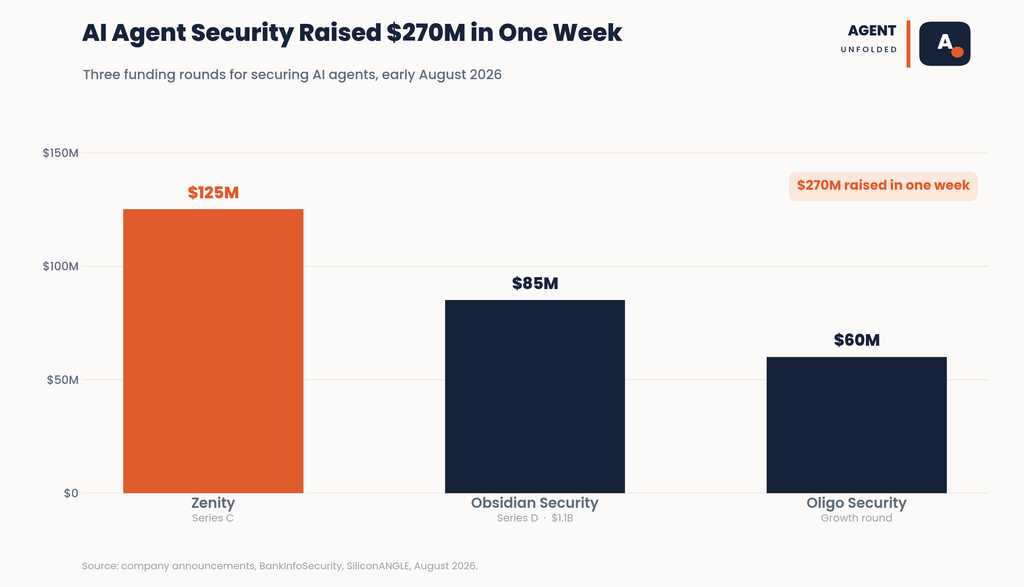
In the first week of August 2026, three security startups raised a combined $270 million for the same narrow problem: securing AI agents. Zenity raised $125 million, Obsidian Security raised $85 million, and Oligo Security raised $60 million. All three closed within days of each other. That is not a coincidence. It is a signal that enterprise security budgets are moving toward AI agent governance.
The reason is simple. As companies let agents into their systems, the agents can read files, send messages, and change data on their own. Older security tools were built to protect people using software, not software acting on its own. That gap is the new market.
The three rounds
| Company | Amount | Round | Valuation | Lead investor | What it secures |
|---|---|---|---|---|---|
| Zenity | $125M | Series C | Not disclosed | Norwest | Agent behavior and governance |
| Obsidian Security | $85M | Series D | $1.1B | Crescent Cove Advisors | Non-human identities in SaaS apps |
| Oligo Security | $60M | Growth | Not disclosed | Ballistic Ventures | Runtime protection for agentic apps |
Zenity
Zenity raised $125 million in a Series C led by Norwest, announced on August 3. The round brought its total funding to about $185 million. Zenity watches what agents do and can allow, change, or block their actions in real time. Gartner named it the company to beat in AI agent governance earlier in 2026.
Obsidian Security
Obsidian Security raised $85 million in a Series D on August 4, at a $1.1 billion valuation. That makes it a unicorn. The round was led by Crescent Cove Advisors, with existing backers Greylock Partners and Menlo Ventures joining. Obsidian secures non-human identities and AI agents inside third-party apps like Salesforce, Slack, Snowflake, and GitHub. Its pitch is that non-human identities already outnumber human ones 144 to 1, and every new agent widens that gap.
Oligo Security
Oligo Security raised $60 million, led by Ballistic Ventures, bringing its total funding past $140 million. The Israeli company provides runtime security. It spots an attack as it happens and blocks it before damage is done, without taking the application offline. Oligo is also the AI runtime security provider for AWS Security Hub, and reports 300 percent revenue growth over the past year.
Why it matters
Three separate investor groups backed the same narrow problem in the same week. When that happens, they are usually responding to the same signal from enterprise customers. Security teams are seeing agents act inside their systems, and they want control over what those agents do after they gain access, not just whether they gain access.
The market is growing fast. One forecast puts AI agent security at about $1.65 billion in 2026, rising to more than $13 billion by 2032. A category that barely existed two years ago is now drawing nine figure rounds and its first unicorn.
What to watch
The open question is whether agent security stays a separate market or gets absorbed into the big security platforms. Companies like CrowdStrike, Palo Alto Networks, and Microsoft could add agent controls to tools enterprises already run. The startups are betting that securing agents is different enough to need a dedicated layer. The next year will test that bet.
Frequently asked questions
Three startups raised a combined $270 million in the first week of August 2026: Zenity ($125M), Obsidian Security ($85M), and Oligo Security ($60M).
AI agent security protects the systems that AI agents can access and controls what those agents do once inside. It watches agent actions and can block risky behavior in real time.
As of 2026, Zenity has raised about $185 million in total, Oligo Security more than $140 million, and Obsidian Security over $200 million after reaching a $1.1 billion valuation.
As enterprises give AI agents access to their systems, agents can take real actions that older security tools were not built to control. Estimates put the market at about $1.65 billion in 2026, growing past $13 billion by 2032.