Agentic AI is the fastest growing category in software. An AI agent is different from a chatbot. A chatbot answers questions. An agent takes action. It can read data, use tools, make decisions, and finish a task with little human help.
This article maps the agentic AI landscape in 2026. It covers the seven main categories of AI agents, the leading companies in each, and the funding behind them. Use it as a starting point, then follow the links to go deeper. It is a living guide and we update it as the market moves.
The main categories at a glance
- Customer service: Decagon, Sierra, Parloa, Wonderful, Ada
- Coding: Cognition (Devin), Cursor (acquired by SpaceX), Replit, Lovable
- Legal: Legora, Harvey, EvenUp, Robin AI
- Healthcare: Abridge, Hippocratic AI, Assort Health, OpenEvidence
- Logistics and operations: HappyRobot
- Infrastructure: LangChain, Glean, Modal Labs
- Agent security: Zenity, Oasis Security
How to read the landscape
Most agent companies fall into one of four groups. Horizontal platforms build agents that many industries can use. Vertical agents go deep into one field, like law or healthcare, and learn its rules. Infrastructure companies build the tools others use to make agents. Security companies protect agents once they are live.
The fastest growth right now is in vertical agents. Depth wins in fields where the work is complex and the cost of a mistake is high.
Customer service agents
The leading customer service AI agents are Decagon, Sierra, Parloa, Wonderful, and Ada. This is the clearest early use case, because the work is high volume and easy to measure.
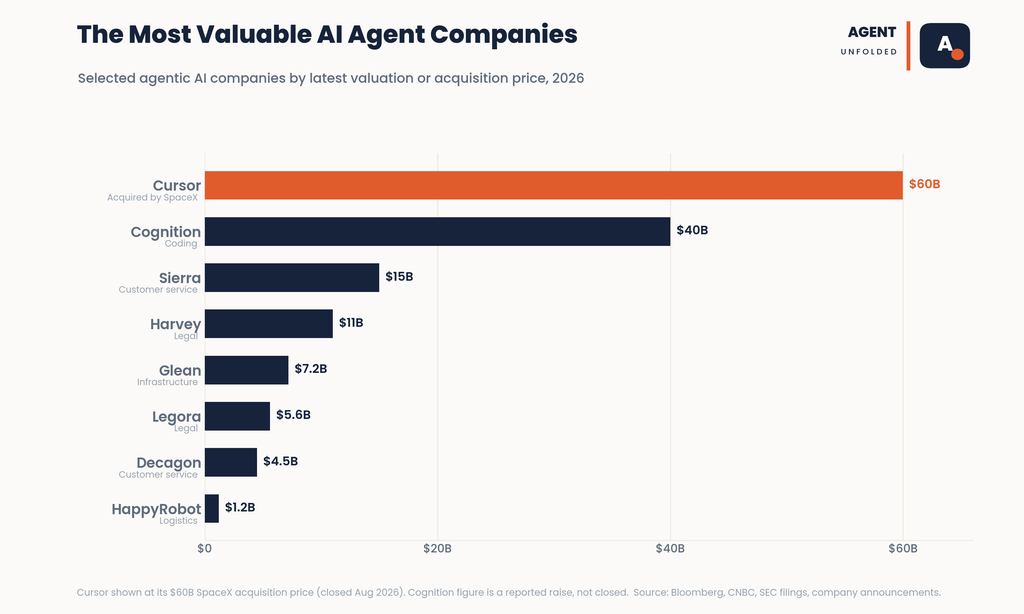
Decagon resolves full customer interactions across chat, voice, email, and SMS, and is valued at $4.5 billion. Sierra, started by Bret Taylor and Clay Bavor, is the best funded name in the space at about $15 billion. Parloa and Wonderful are both growing fast, and Ada is a long standing player now built around agents.
Coding agents
The top AI coding agents are Cognition, Cursor (acquired by SpaceX), Replit, and Lovable. Coding has the highest search interest of any agent category, and some of the largest valuations.
Cognition makes Devin, an agent that can plan and build software on its own. Cursor is the breakout AI code editor, and SpaceX acquired it for $60 billion in August 2026, the largest startup acquisition ever. Replit and Lovable let people build full apps from plain language. These tools are moving from code suggestions to agents that plan and ship.
Legal agents
The leading legal AI agents are Legora, Harvey, EvenUp, and Robin AI. Legal is proving to be one of the most valuable agent markets, because the work is heavy on documents and firms bill by the hour.
Legora and Harvey are the two leaders, and their rivalry defines the space. Legora was valued at $5.6 billion in early 2026 and is reportedly in talks to raise at more than $10 billion. Others like EvenUp and Robin AI hold strong positions in narrower slices of legal work.
Healthcare agents
The main healthcare AI agents are Abridge, Hippocratic AI, Assort Health, and OpenEvidence. Healthcare is a high conviction bet, because the paperwork is endless and staffing shortages are real.
Abridge turns clinical conversations into notes and is one of the most valuable healthcare AI companies. Hippocratic AI builds patient facing voice agents. Assort Health handles patient calls and scheduling. OpenEvidence supports clinical decisions with cited medical evidence. Trust and safety are the hard part here, which slows adoption but raises the reward.
Logistics and operations agents
The clearest leader in logistics and operations agents is HappyRobot. These agents do the unglamorous work that keeps businesses running, like phone calls, scheduling, and coordination.
HappyRobot started in freight, one of the hardest industries to automate, and is now valued at $1.2 billion. It is expanding into energy, insurance, and telecom. This category is small today but has room to grow across the whole real economy.
Agent infrastructure
The main agent infrastructure companies are LangChain, Glean, and Modal Labs. This group sells to developers rather than to end users.
LangChain provides the frameworks and orchestration that agents run on. Glean builds enterprise search and work assistants. Modal Labs runs the compute that agents need to execute. As more companies build their own agents, this layer gets more valuable.
Agent security and governance
The leading agent security companies are Zenity and Oasis Security. Once agents can take real actions, they become a new kind of risk, and securing that is now its own market.
Zenity is the early leader, named by Gartner as the company to beat in agent governance. Oasis Security works on agent identity and access. This category barely existed two years ago and is now drawing nine figure rounds.
The money behind agentic AI
Funding tells the same story as the product map. Capital is moving away from general AI research and toward agents that do specific, high value work.
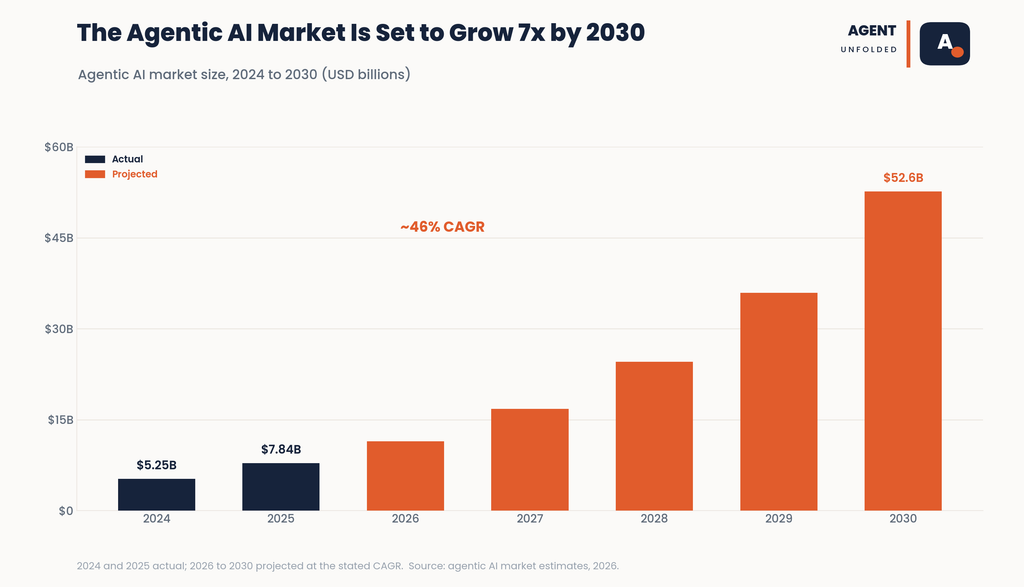
Market estimates put the agentic AI market at roughly $8 billion in 2025, with forecasts reaching around $50 billion by 2030. Gartner expects about a third of enterprise software to include agentic AI features by 2028. Round sizes are climbing too. The average agentic AI round in late 2025 and early 2026 reached about $155 million, nearly double the first half of 2025.
You can follow the latest rounds in our Funding section, including HappyRobot’s $150M Series C, Zenity’s $125M Series C, and the reported talks around Legora’s $10 billion valuation.
What to watch
Three things will shape the next year in this market.
Reliability is the real bottleneck. An agent that works 95 percent of the time is not good enough for mission critical work. Pricing is shifting from per seat to per outcome, which ties vendors to results. And general AI models keep improving, which is a constant threat to the simpler end of every vertical.
We will keep tracking all of it here, one company at a time.
Frequently asked questions
Agentic AI refers to AI systems that can take actions on their own, not just answer questions. An AI agent can read data, use tools, make decisions, and complete multi step tasks with little human help.
A chatbot answers questions and returns information. An AI agent goes further and takes action, such as processing a refund, booking a meeting, or writing and shipping code. Agents work across systems, while chatbots mostly talk.
The main categories of AI agents in 2026 are customer service, coding, legal, healthcare, logistics and operations, infrastructure, and agent security.
Leading AI agent startups include Sierra and Decagon in customer service, Cursor (acquired by SpaceX) and Cognition in coding, Harvey and Legora in legal, Abridge in healthcare, HappyRobot in logistics, and Zenity in agent security.
The most valuable is Cursor, which SpaceX acquired for $60 billion in 2026, the largest startup acquisition ever. Among independent startups, Cognition leads at a reported $40 billion, followed by Sierra at about $15 billion.
Market estimates put the agentic AI market at roughly $8 billion in 2025, with forecasts reaching around $50 billion by 2030.